Everyone Gets
a Table

EquiTable is a recognition for restaurants on District by Zomato, earned with five checks, so a group knows before leaving home that everyone at the table can get in, sit down and order for themselves. This is the story of one Saturday dinner it was designed for, told the way I pitched it: through one booking, one family and one evening. Along the way are the outputs: the brand, the screens in the District app, eleven pieces in the restaurant and two launch films.

Tools UsedFigma, Claude, Premiere Pro, Google Flow
Channels Impacted DirectlyDistrict App, In-Restaurant Experience, LinkedIn, Instagram (Hypothesis)
Skills DemonstratedBrand Identity, Brand Strategy, Storytelling, Inclusive Design, Service Design, Physical Experience Design, UI Design, Motion Design, Tone of Voice
EquiTable title board: the leaning table mark, the EquiTable wordmark and the line One table. Every guest., in English and Hindi, on District purple

Part one of three

Rahul’s Saturday

A brand for accessible dining is easy to make sound like compliance. So I started with a person, a booking and an evening, and let every piece of the system earn its place in his day.

Rahul is booking Saturday dinner. For eight people, and a baby

His mother and father, three friends, and a couple with their first baby. In every group someone checks before they book. In this one it is Rahul, and seven people are counting on his choice.

RRahulBooks the table
  • MaaHis mother
  • PapaHis father. Walks with a stick
  • NehaA new mother
  • ArjunA new father
Saturday, 8 pm · Table for eight
  • KabirUses a wheelchair
  • AmanIs blind
  • MeeraDoesn’t speak
KKiaanEight months. In a stroller

Seven guests. Five different needs. One booking to get right.

It used to take an afternoon of phone calls

For every restaurant on his list, the same questions. And the same answer.

  1. For Kabir“Do you have steps at the door?”
  2. For Kabir“Is there a lift? Will a wheelchair fit in it?”
  3. For Aman“Do you have a menu in braille?”
  4. For Maa and Papa“Is it well lit? Can they read the menu?”
  5. For Meera“My friend doesn’t speak. Will your staff manage?”
  6. For Neha and Arjun“Is there room for a stroller at the table?”
  7. The restaurant“I’m not sure, sir. Let me check and call you back.”

Rahul’s table isn’t unusual

His party covers five of the seven kinds of guest EquiTable is designed for.

  • Uses a wheelchair
  • Blind or low vision
  • Deaf or hard of hearing
  • Non-speaking
  • Older guests
  • Expecting
  • With an infant
2.68 crore

people in India live with a disability.

16.7 crore

people in India are aged 60 or above.

And they rarely eat alone.

Friends, parents, children and colleagues come with them.

Sources: Census of India, 2011 (disability); JLL report, 2026 (aged 60 or above).

Then EquiTable

The same Saturday, with EquiTable live on District. Eleven stops, from a post in his feed to a photo on the way out, each answering one question the phone calls used to ask. The Riverside Inn, Rahul and his party are a worked example, and the photographs are generated visualisations.

11:02 amOn Instagram

Then District shows up in his feed

A sponsored post between two reels. It is the first Rahul has heard of EquiTable. He taps “Open app”.
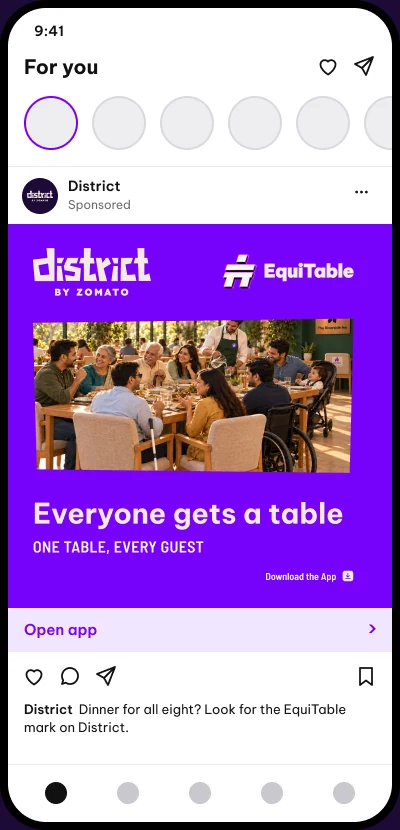
Instagram feed with a sponsored District post: Everyone gets a table, One table, every guest, with an Open app button

Output · District ad, Instagram feed

11:03 amOn the District app

Which places work for all eight?

He lands in Dining. EquiTable has its own banner and its own row. District asks who’s coming, once, and three places nearby work for all eight.
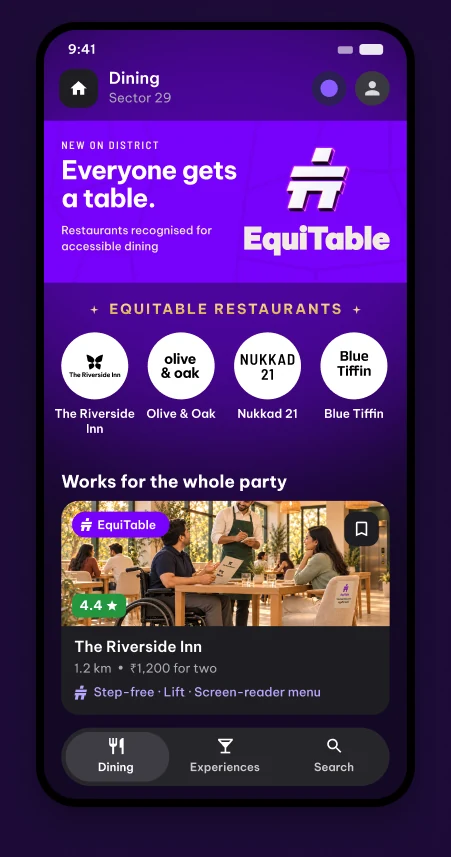
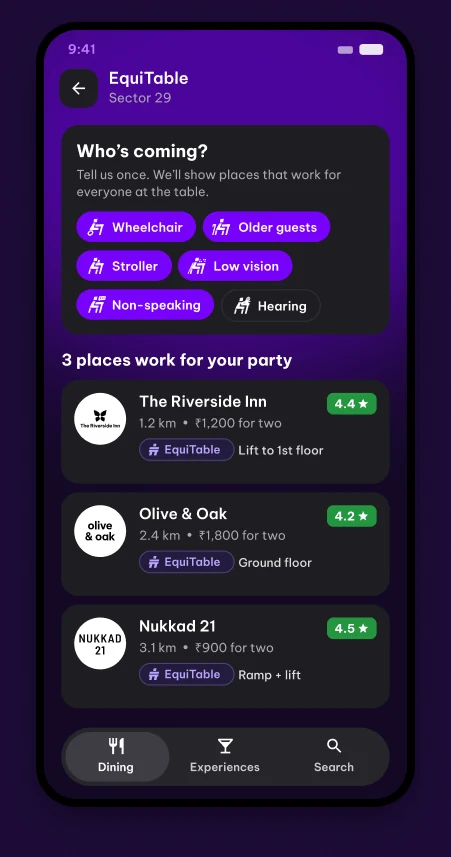
District Dining home with an EquiTable banner, a row of EquiTable restaurants and a Works for the whole party cardWho’s coming? chips for wheelchair, older guests, stroller, low vision and non-speaking, and three places that work for the party

Output · Dining home and Who’s coming?, District app

11:06 amOn the District app

Will it really work for them?

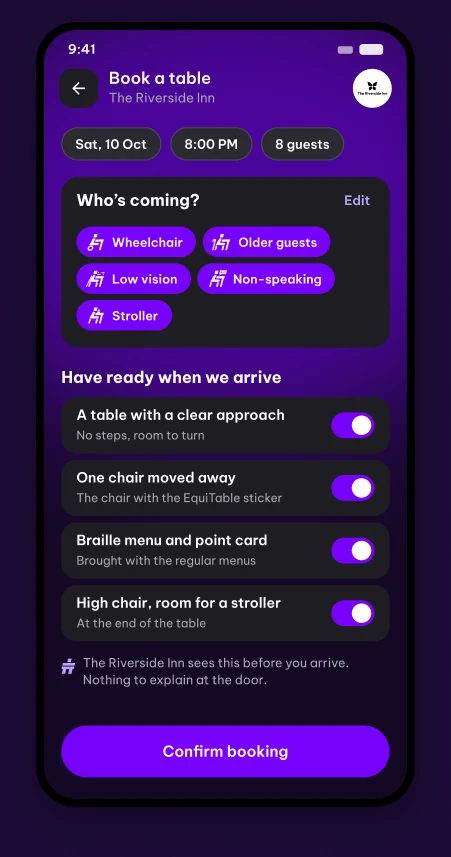
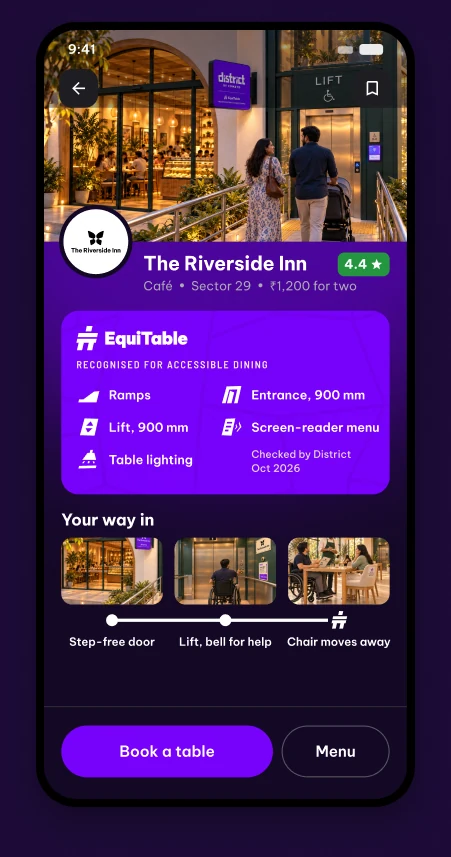
The Riverside Inn’s page shows the five checks and the way in, in photos. Rahul books for eight and says what to have ready. No phone call.

What The Riverside Inn sees, straight away

Sat 10 Oct · 8:00 pm
Table for 8, and a baby
  • Clear approach. One chair moved away
  • Braille menu and point card on the table
  • High chair, and room for a stroller
The Riverside Inn’s page with the EquiTable panel listing the five checks and a Your way in strip of photosBooking for eight on Saturday at 8 pm with toggles for a clear approach, one chair moved away, braille menu and point card, and a high chair

Output · Restaurant page and booking, District app

7:15 pmOn the way

Aman hears the menu on the way there

In the cab, his phone reads it to him one dish at a time. He never hears a price without its dish, or a button without its name. The Riverside Inn uploaded the menu it already had, and District formatted it for screen readers. That is check 4 of 5.
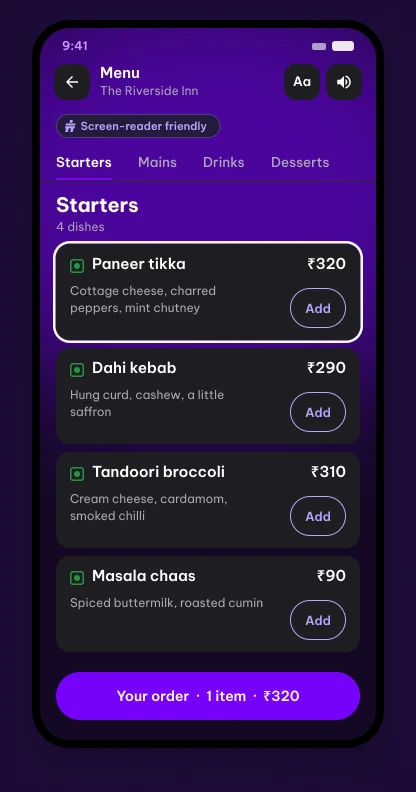
  1. “Menu. The Riverside Inn. Heading.”
  2. “Starters. Tab, one of four, selected.”
  3. “Starters. Heading. Four dishes.”
  4. “Paneer tikka. Vegetarian. 320 rupees. Cottage cheese, charred peppers, mint chutney.”
  5. “Add Paneer tikka to your order. Button.”
Screen-reader friendly menu: each dish, its price and description grouped so a screen reader reads them together

Output · Screen-reader menu, District app

7:40 pmThe street and the door

Can we all get in here?

Papa spots the sign from the cab. Neha and Arjun push the stroller up the ramp, and Kabir rolls up behind them. The door says it again at eye level. Nobody goes in first to check.
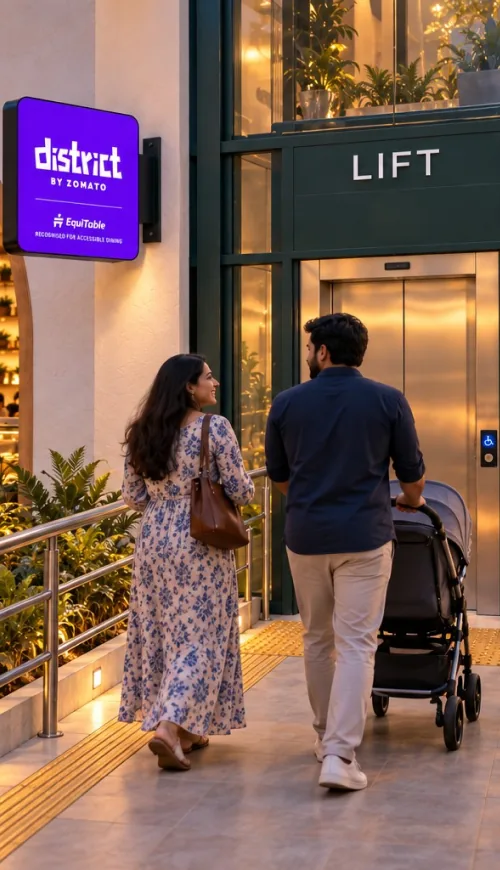
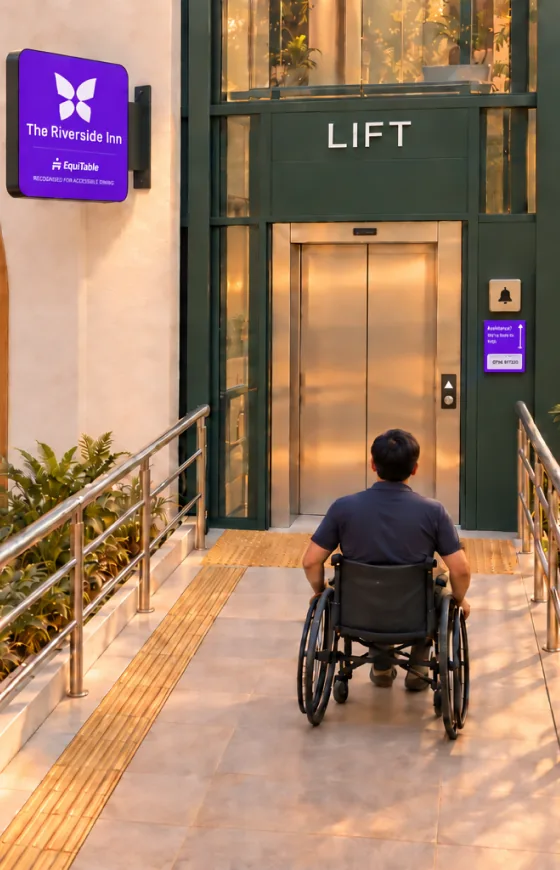
Visualisation of Neha and Arjun pushing a stroller up the ramp past the District face of the lollipop signVisualisation of Kabir rolling up the ramp towards the lift, the partner face of the lollipop sign above
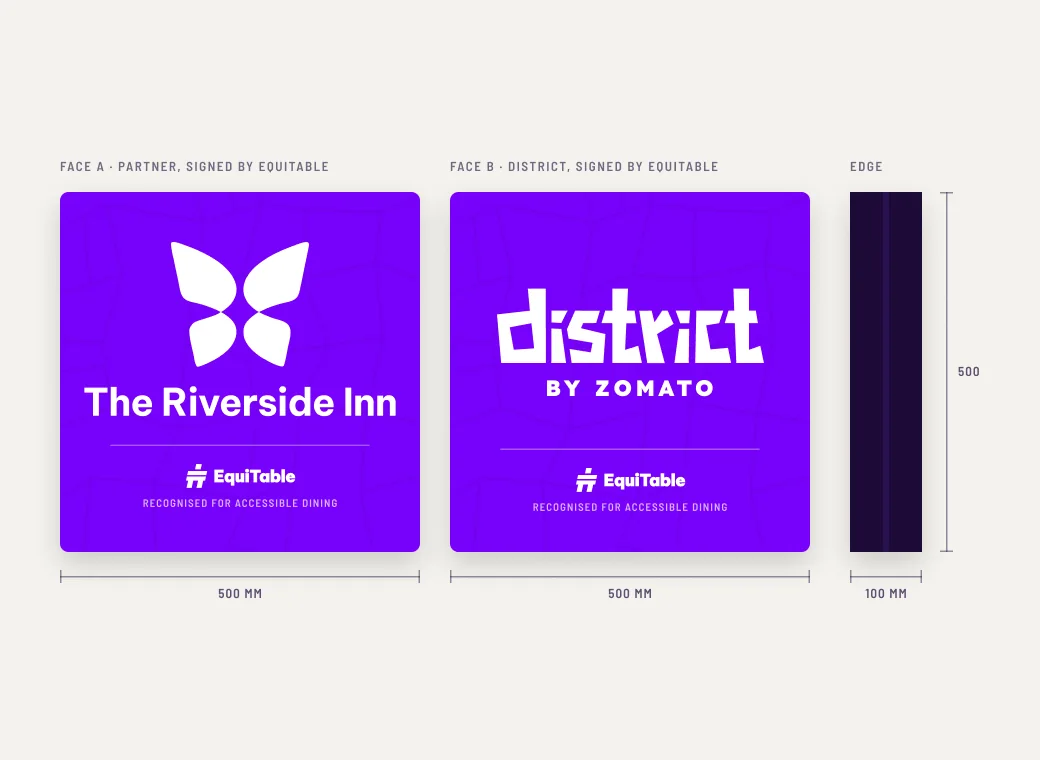
Lollipop sign, 500 by 500 mm: face A, The Riverside Inn signed by EquiTable; face B, District signed by EquiTable
Output · Lollipop sign, two faces, 500 × 500 mm
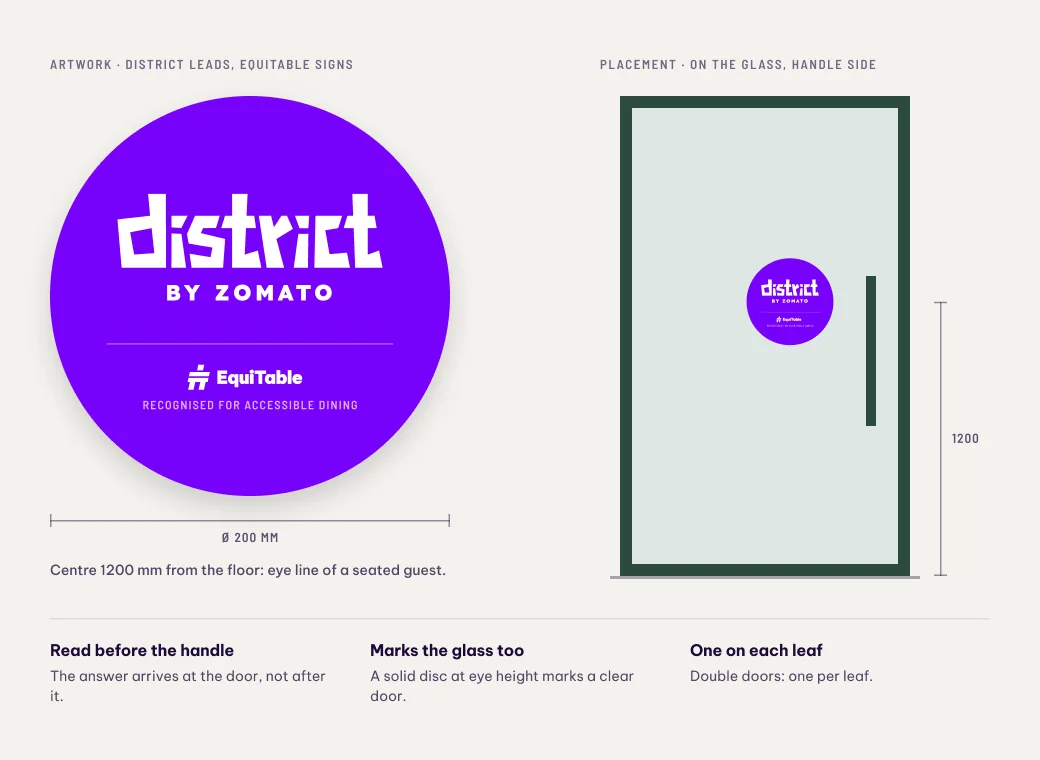
Glass door sticker, 200 mm across, centred 1200 mm from the floor, at the eye line of a seated guest
Output · Glass door sticker, Ø 200 mm, at a seated guest’s eye line
7:44 pmThe lift

What if I need a hand?

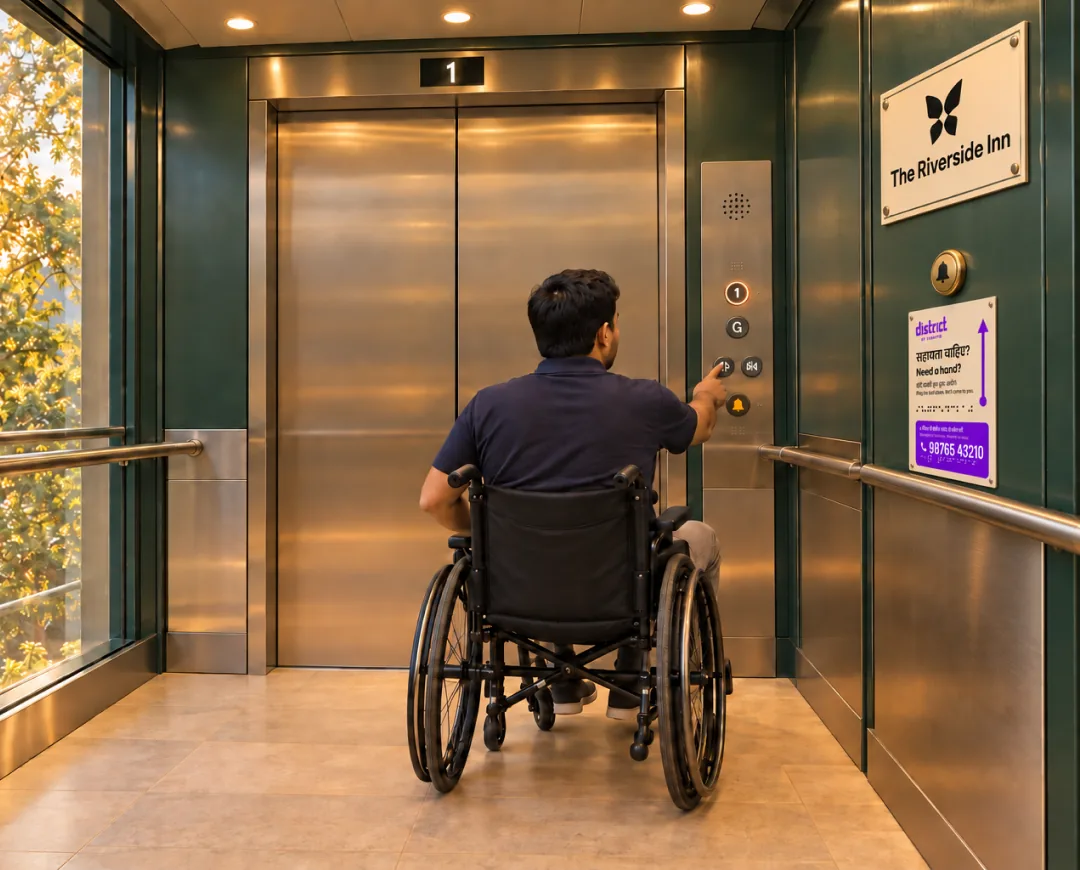
Kabir takes the lift on his own. The bell is there if he wants it, and a number if nobody comes in two minutes. The poster says it in English, Hindi and braille, so Aman can read it too.
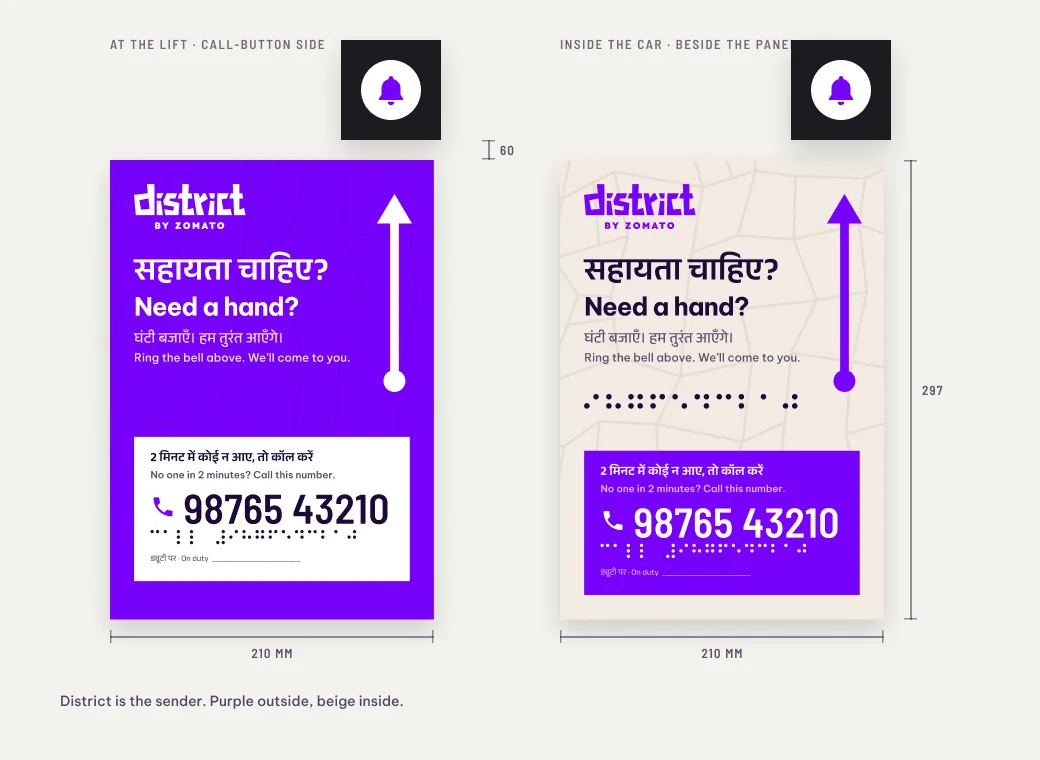
Two A4 lift posters in English, Hindi and braille: Need a hand? Ring the bell above, with a duty number. Purple at the lift, beige inside
Output · Lift posters, A4, in English, Hindi and braille
Visualisation of Kabir in the lift pressing the button, the bell and the Need a hand? lift poster on the wall
7:46 pmArriving, and the table

Do they know we’re coming?

They do. The waiter with the badge meets Kabir at the lift. The table for eight has one chair already moved for him, room for Kiaan’s stroller, and a chair held for Maa.
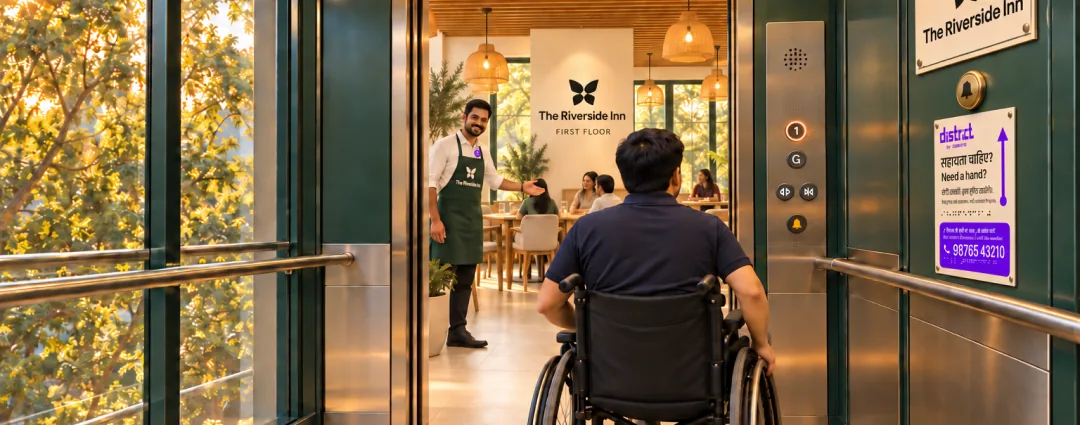
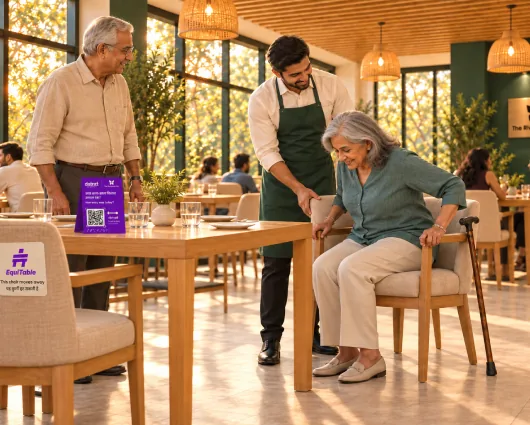
Visualisation of the lift doors opening onto the restaurant floor, the waiter with the EquiTable badge welcoming KabirVisualisation of the waiter helping Maa sit down, a chair-back sticker on the next chair
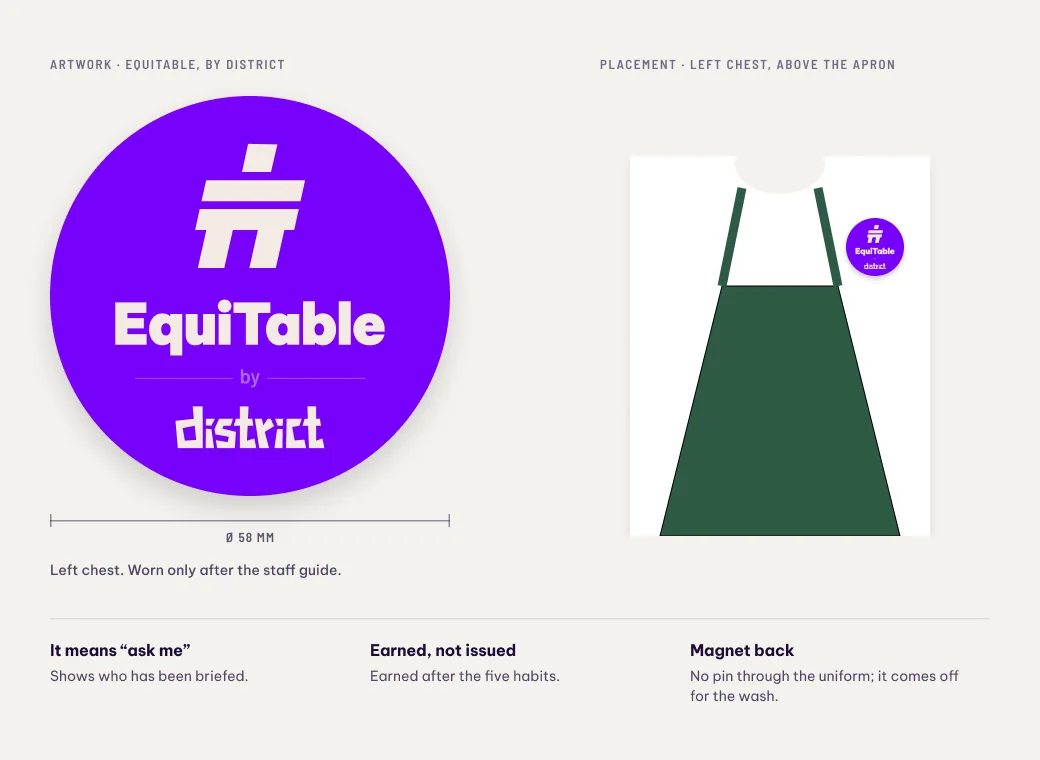
Waiter badge, 58 mm across, EquiTable by District, worn on the left chest after the staff guide
Output · Waiter badge, Ø 58 mm, earned after the staff guide
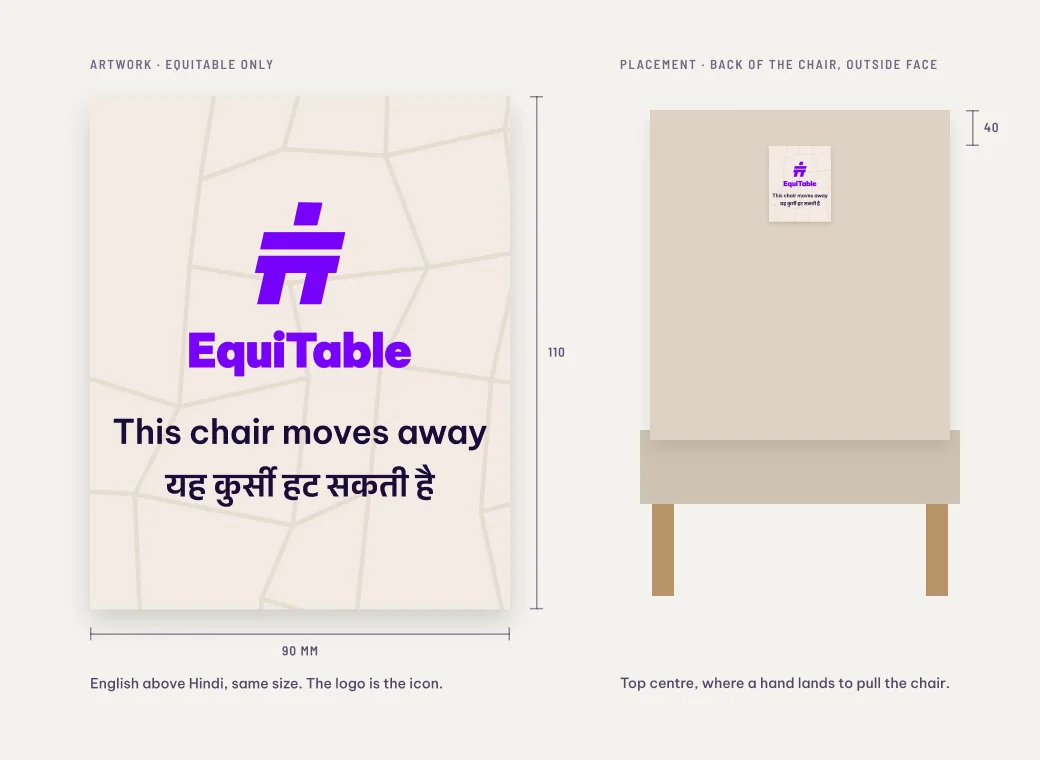
Chair-back sticker, 90 by 110 mm: This chair moves away, in English and Hindi
Output · Chair-back sticker, 90 × 110 mm
7:55 pmOrdering

Can each of us order for ourselves?

Aman reads the braille. Maa and Papa read the large print. Meera points at the card, and the waiter says it back.
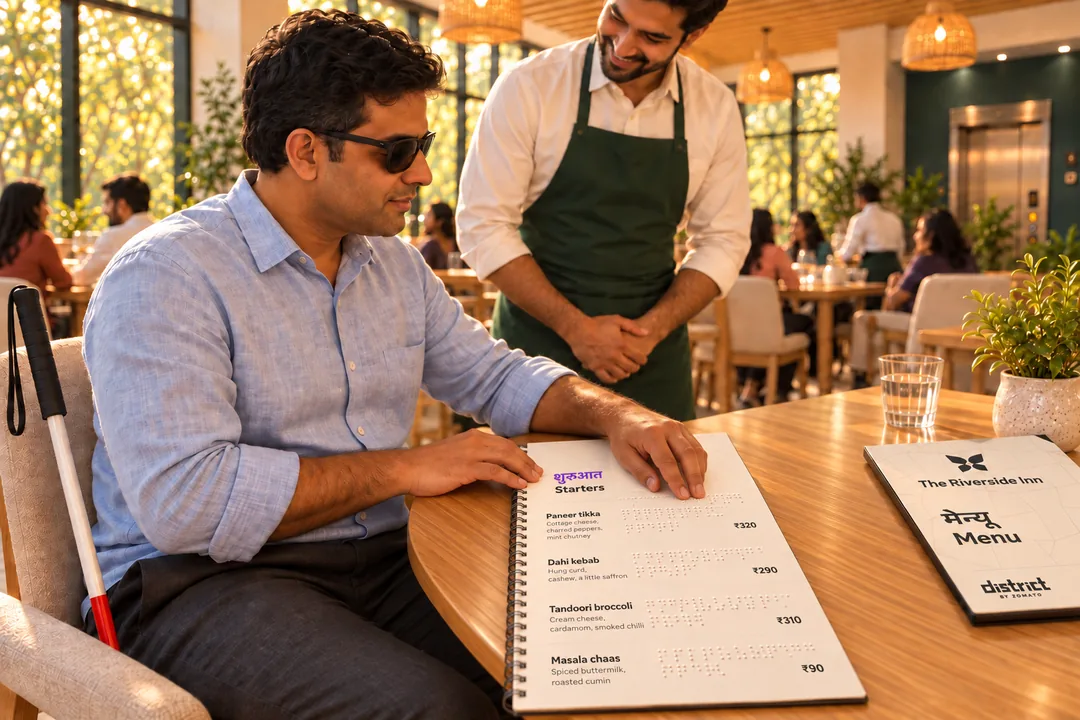
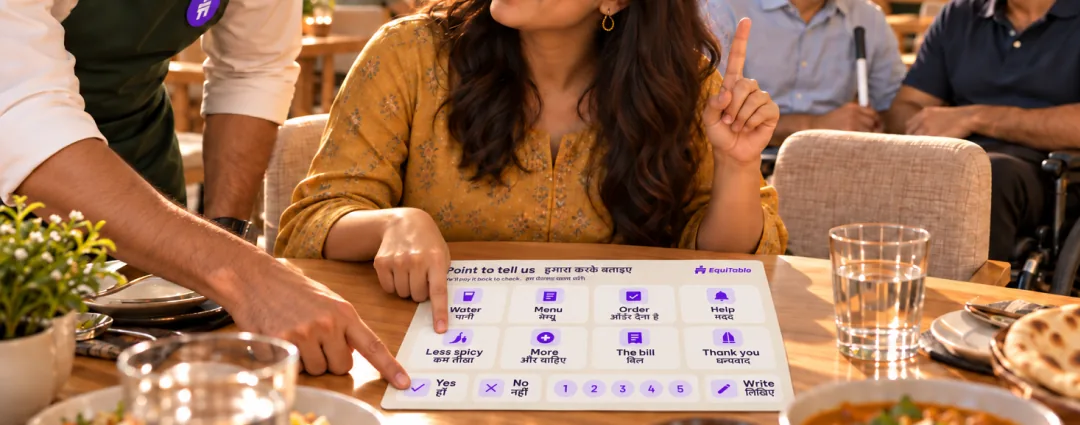
Visualisation of Aman reading the braille and large-print menu with his fingertips, the waiter waiting beside him and his cane resting against the chairVisualisation of Meera pointing at the point card on the table: water, menu, order, help, less spicy, more, the bill, thank you
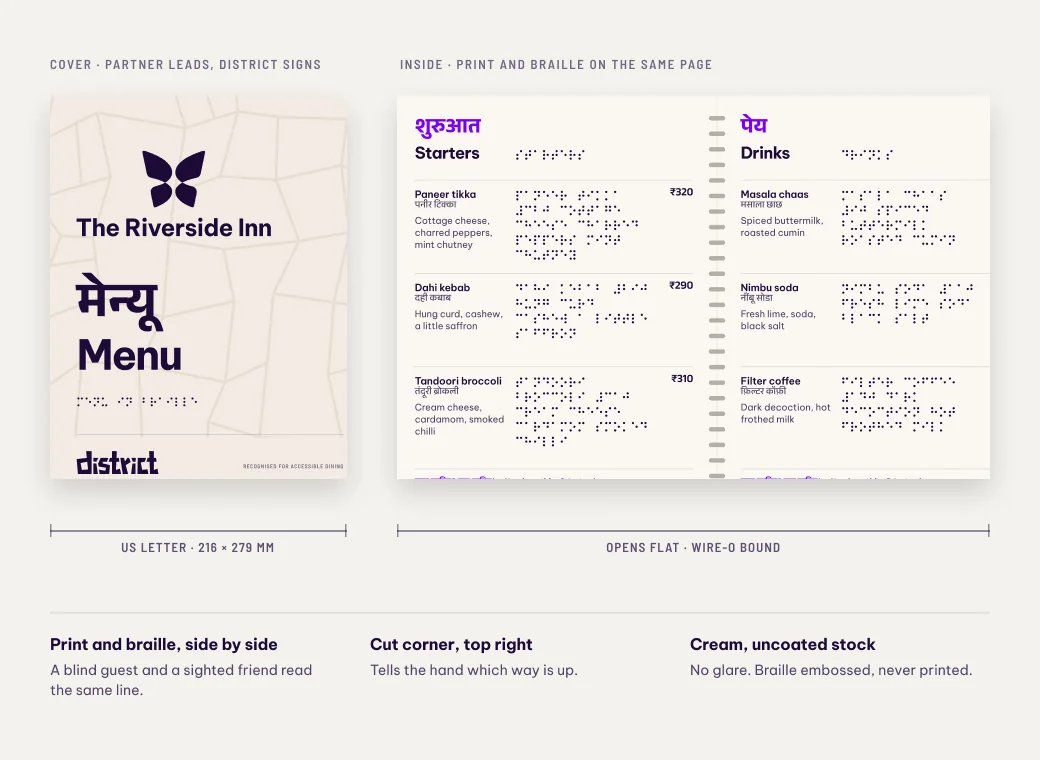
Braille and large-print menu: cover, and inside pages with print and braille side by side
Output · Braille + large-print menu, US Letter, wire-O bound
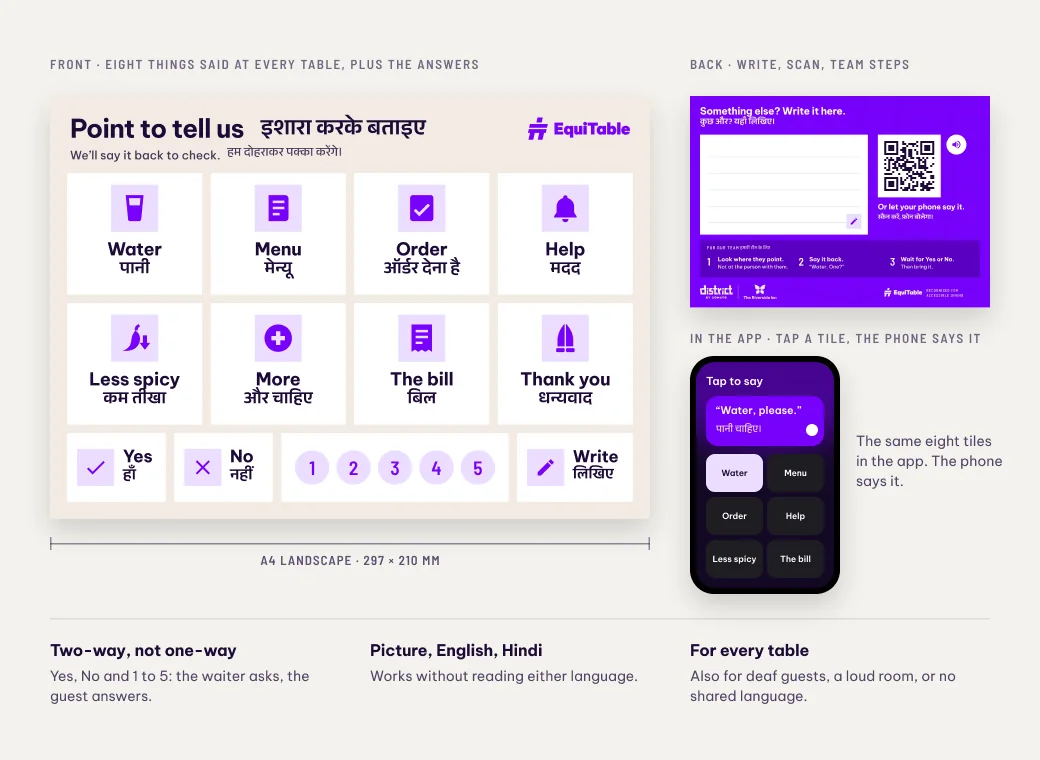
Point card, A4 landscape: eight tiles in picture, English and Hindi, yes, no and 1 to 5, with the same tiles in the app
Output · Point card, A4, with the same tiles in the app
9:20 pmPaying

Can I check the bill myself?

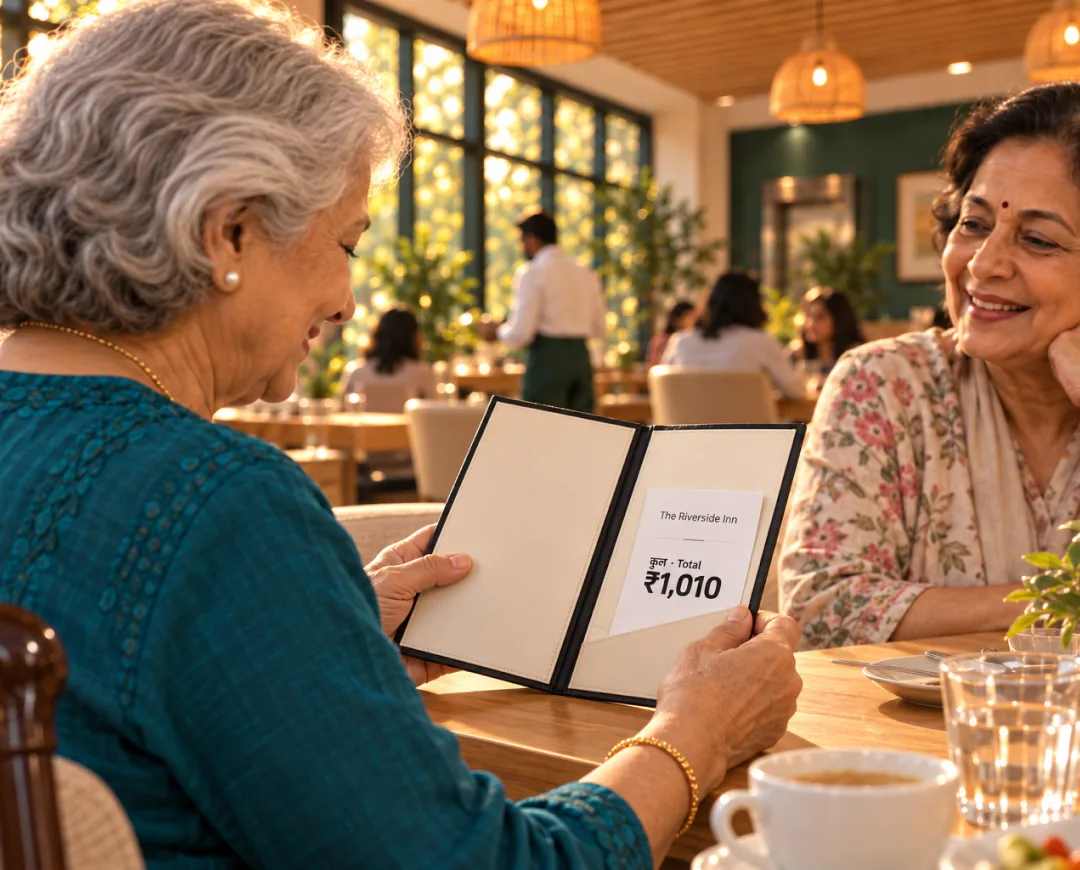
Maa asks for it in large print, reads every line, and tells Rahul to put his wallet away.
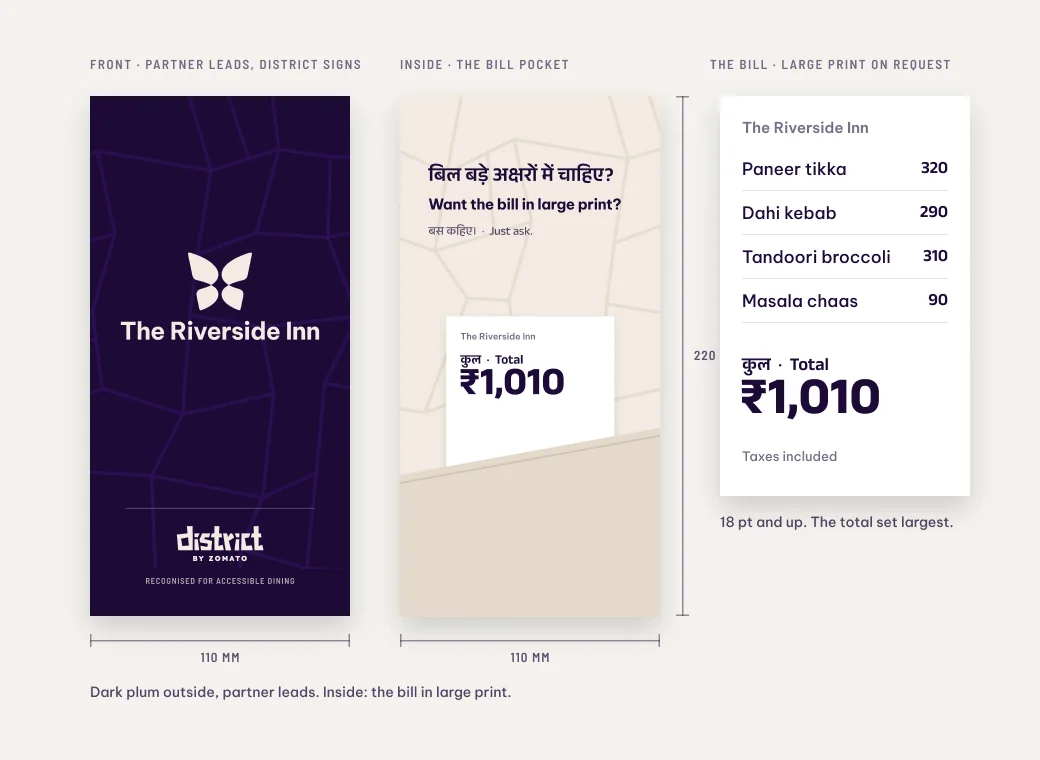
Billing folder, 110 by 220 mm: dark plum front, a pocket asking Want the bill in large print?, and the large-print bill
Output · Billing folder and large-print bill
Visualisation of Maa reading the large-print bill in the billing folder, smiling
9:25 pmBefore leaving

Does anyone ask how it went?

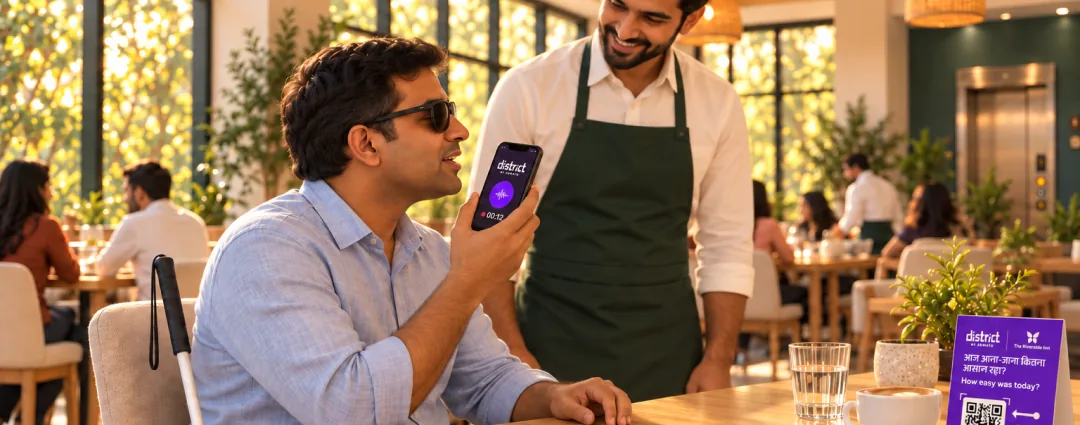
Three questions from the tent on the table. Kabir taps his answers. Aman says his into the District app. Feedback comes before the photo, so the last thing a guest does is a happy one.
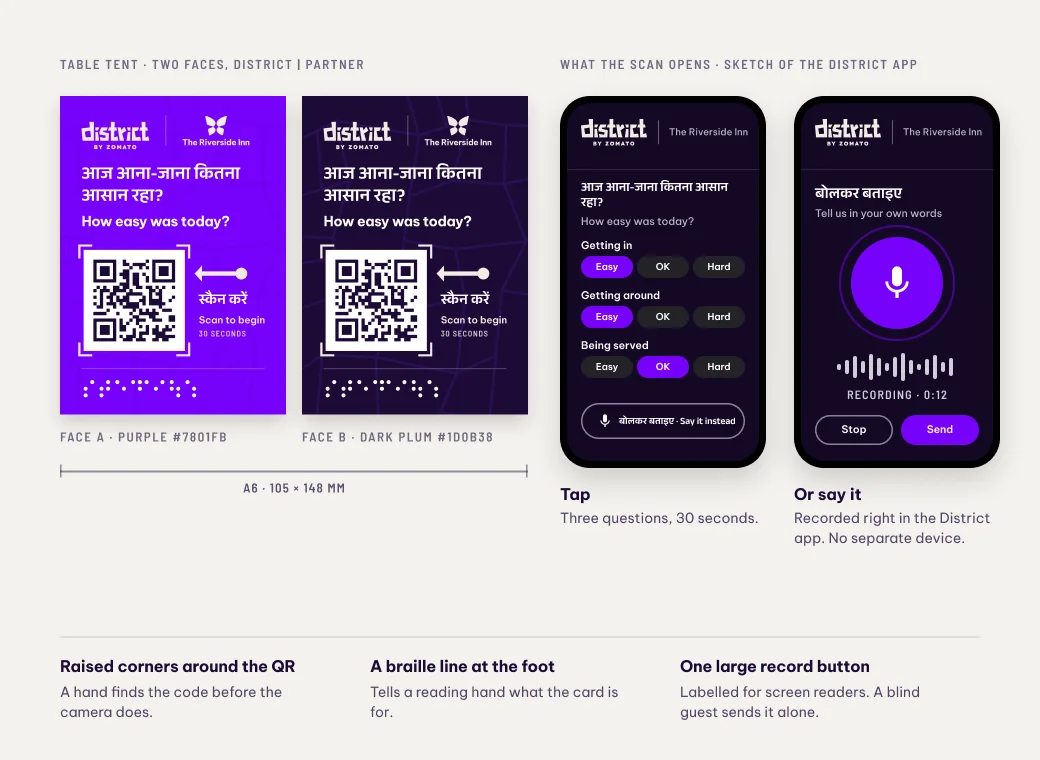
Feedback tent, A6, two faces with a QR in raised corners, and the District app screens it opens: tap three answers or say it
Output · Feedback tent, A6, and the screens it opens
Visualisation of Aman saying his feedback into the District app, the feedback tent on the table
9:40 pmLeaving

Do we take tonight home?

All eight of them, and baby Kiaan, in one frame. This piece removes no barrier. It is there because they had a good evening.
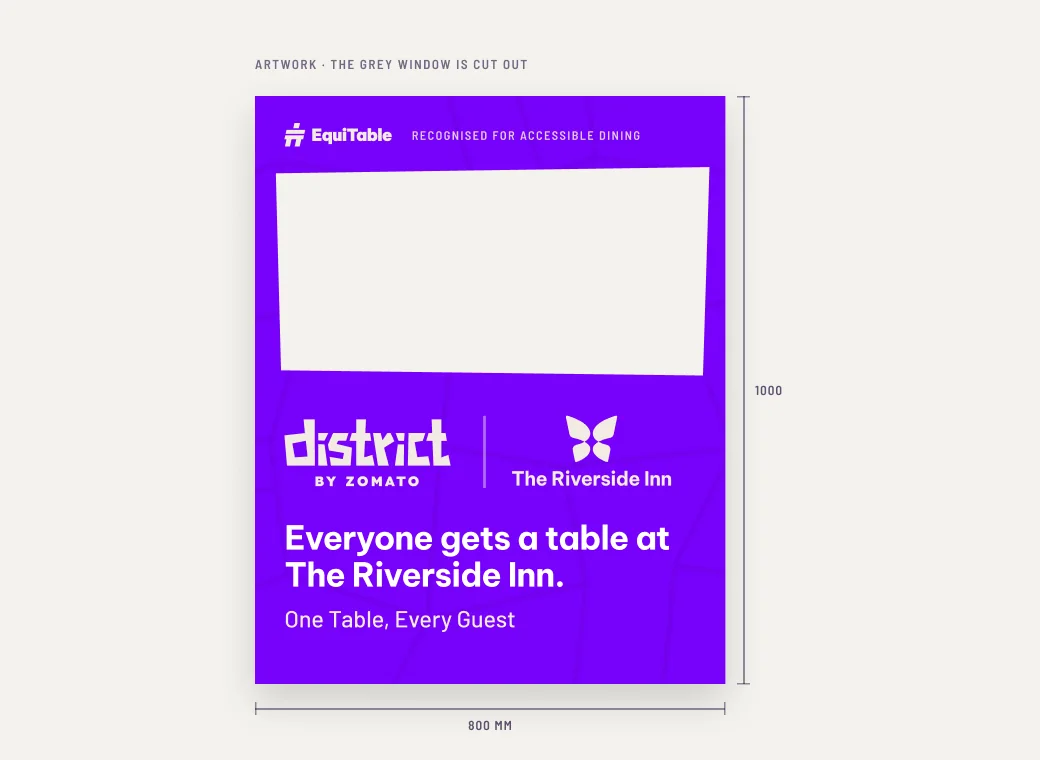
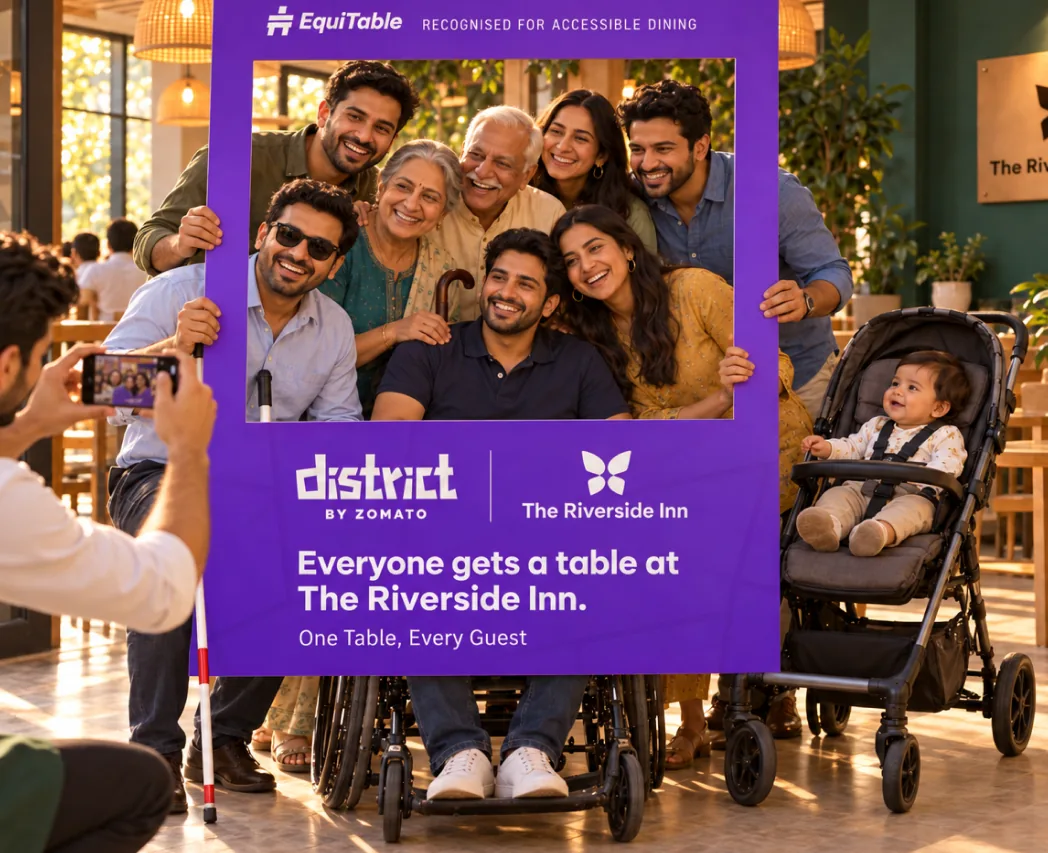
Family photo cutout, 800 by 1000 mm, with a window cut out above Everyone gets a table at The Riverside Inn
Output · Family photo cutout, 800 × 1000 mm
Visualisation of Rahul’s whole party, including Kabir in his wheelchair, Aman with his cane and baby Kiaan in the stroller, in the family photo cutout

Saturday, 9:45 pm. Nobody had to call ahead.

Rahul made one booking on the District app. The Riverside Inn did the rest: in the street, at the door, at the table.


Part two of three

The brand

Everything Rahul met was one system: a name, a mark, a voice and a set of rules. It lives inside District’s own brand, so from here on the work is shown in District’s colours.

A District recognition for restaurants where everyone can eat out together

Guests meet it twice: in the District app while they choose, and at the door when they arrive. Its mission is to make eating out together ordinary, for every guest.

  1. Check 1Ramps between levels
  2. Check 2A lift with a 900 mm door
  3. Check 3An entrance 900 mm wide
  4. Check 4A menu screen readers can read
  5. Check 5Extra table lighting, on request

Swipe to see all five →

One books the table. One owns it

The brand has to work for two people at once: the guest who plans the evening, and the owner deciding whether to join.

Portrait of Rahul, the guest who books the table

The guest side

Rahul, who books the table

Plans for the group, and takes the blame when the evening goes wrong.
Wants
To know before they travel
Everyone managing on their own
An ordinary evening out
Worries
Choosing the wrong place for eight
A promise that isn’t kept
A friend being talked over
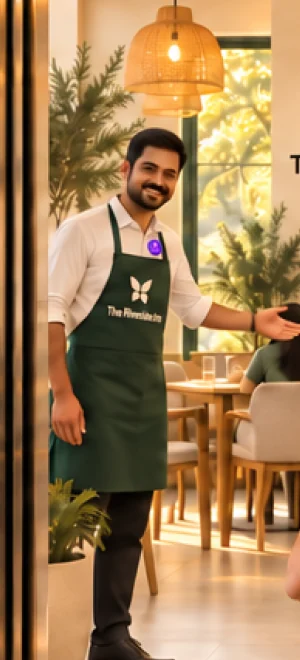
The owner of The Riverside Inn welcoming guests in an apron

The partner side

The owner with a room to fill

Runs a good restaurant and wants more full tables. Would like to do the right thing, without hiring a consultant to find out how.

Wants
Full tables on quiet nights
A reason to be chosen
A clear list of what to fix
Worries
Cost and disruption
Getting it wrong in public
Staff who don’t know what to say

Everyone gets a table

One promise, held up by three things for the guest and three for the restaurant.

The same table, not special treatment.
Everyone gets a table.
  • Known before you go
  • Do it yourself
  • Works for the whole party
  • New customer demand
  • Stands out in Dining
  • Guided to qualify
For the guestFor the restaurant

If EquiTable were a person, who would it be?

  • A carer?No. Nobody came out to be looked after.
  • An inspector?No. The checks are how we start, not who we are.
  • A good host?Yes. A good host notices, makes room, and then lets you get on with your evening.

We are

Welcoming

We say hello before we say rules.

Need a hand? Ring the bell above.

Plain

Short words. One idea at a time.

This chair moves away.

Respectful of independence

We offer. The guest decides.

Want the bill in large print? Just ask.

We are not

Pitying

Sympathy nobody asked for.

We understand how hard it is for you to eat out.

Clinical

Policy language at a dinner table.

Persons with disabilities may request staff assistance.

Heroic

Making guests into an inspiration.

Our brave guests inspire us every day.

Equal, and at the table

“Equi” for equal. “Table” for the table. The mark is built from three shapes, so it still holds at 24 px in a District listing, and it leans 12°, like someone pulling up a chair.

  1. Step 1: two purple bars, an equals sign1 · Two barsAn equals sign. Every guest counts the same.

  2. Step 2: two legs added, the lower bar becomes a table2 · Add two legsThe lower bar becomes a table.

  3. Step 3: one block added above, a guest at the table3 · Add one blockA guest takes their place at it.
  4. The EquiTable logo: the leaning table mark above the EquiTable wordmark on District purpleThe logoThe table leans forward. The name stands upright.

District’s colours, type and map. One mark of its own

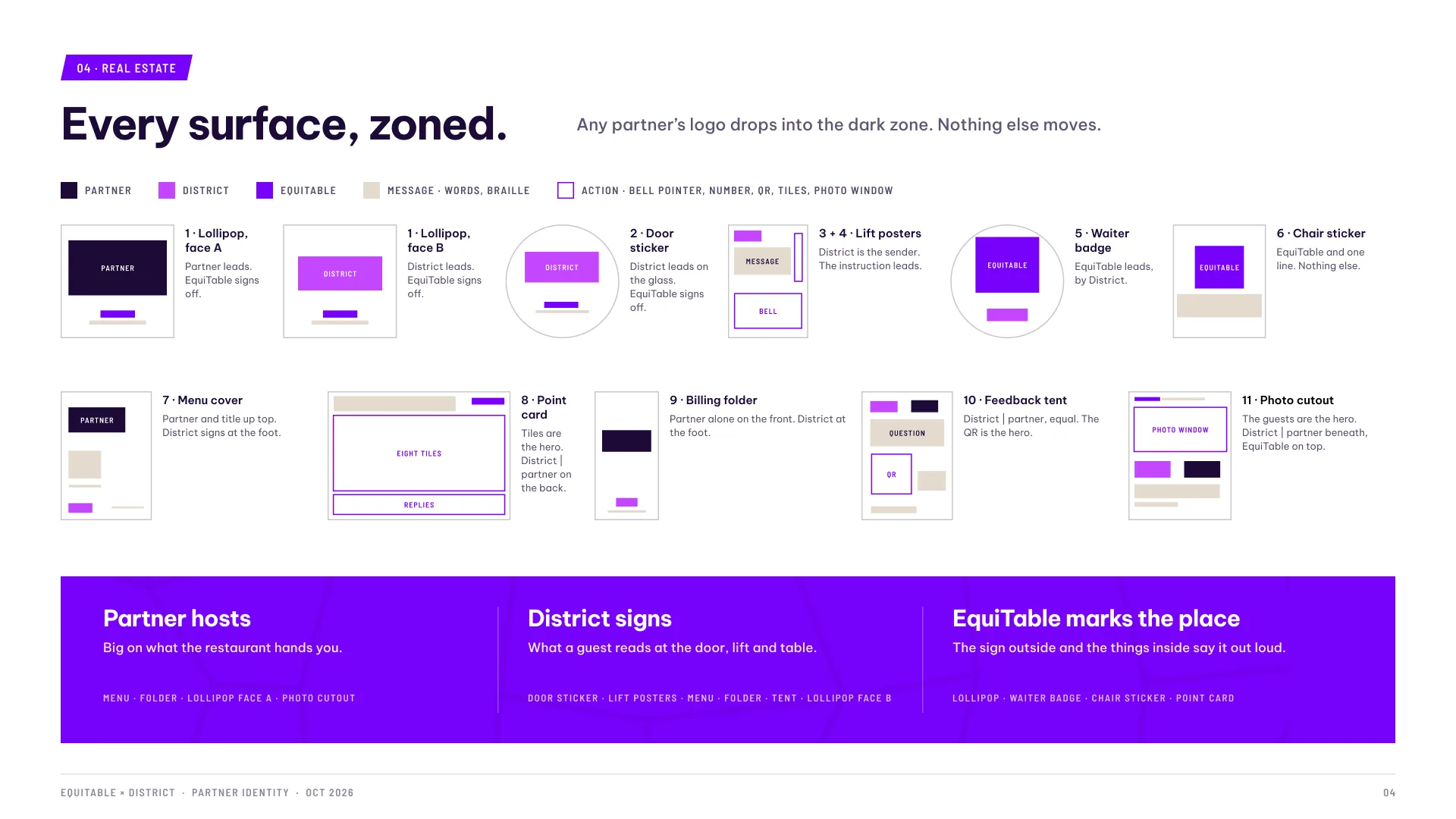
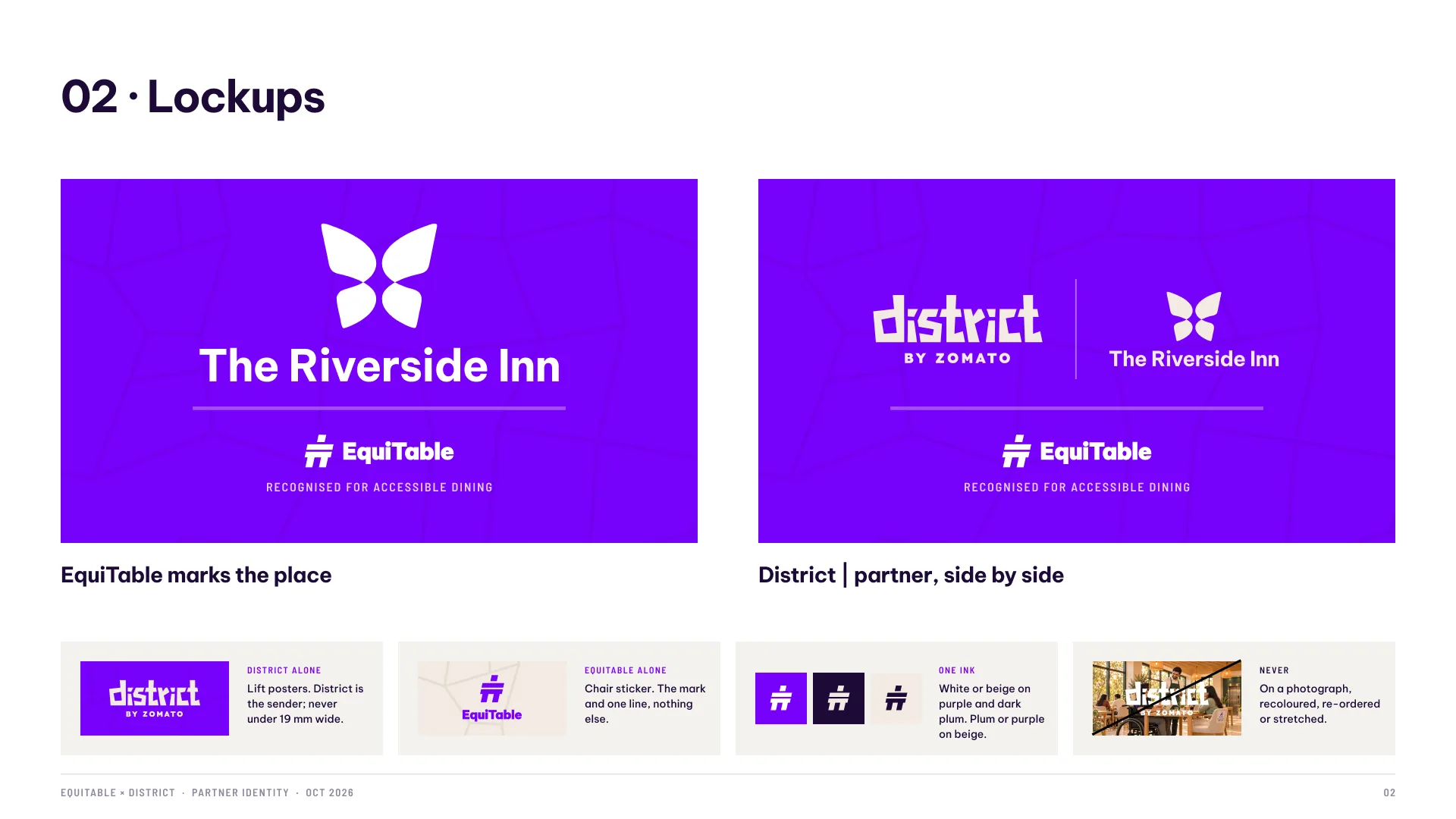
A second visual system would have looked like a third party, so EquiTable borrows District’s colours, type and map and adds one thing: the mark. Every icon is cut from it, with the same bars, the same lean and one ink. Three logos share every surface by one rule: the partner hosts, District signs, EquiTable marks the place.
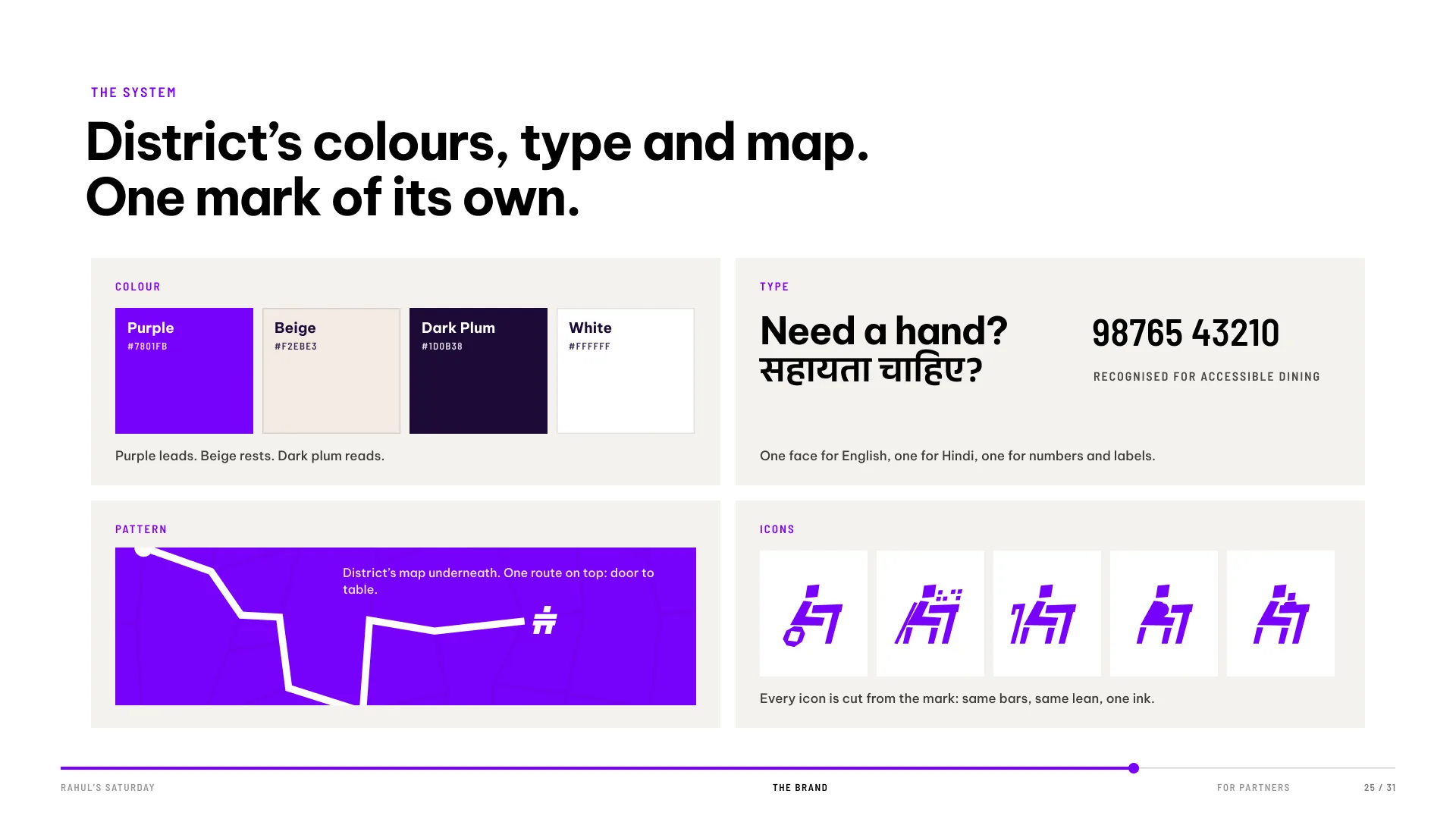
System board: purple, beige, dark plum and white; one face each for English, Hindi and numbers; District’s map with one route on top; five icons cut from the mark
Output · Colour, type, pattern and icons
Lockups board: partner with EquiTable sign-off, District and partner side by side, and the one-ink and never rules
Output · Lockups
Real estate board: every surface zoned for partner, District, EquiTable, message and action
Output · Every surface, zoned

What I chose not to do

Accessibility usually reads as compliance: a checklist, a wheelchair icon, a blue sticker. EquiTable had to read as hospitality, so most of the work was deciding what to leave out.


Left outWhyInstead
The wheelchair symbolOne need as the face of seven.A table, and a guest.
Accessibility blueReads as regulation.District’s purple.
Eco and social-good cuesA cause, not hospitality.A lightbox, a badge, a menu.
“Accessible for everyone”Five checks cannot promise it.“More people at the same table.”
A separate appDiscovery happens where booking happens.A tag, a row, a page in District.
Dropped route A: the straight table mark with a word mixing two scripts
Dropped · The straight table, mixed wordOne word in two scripts: read aloud, it becomes “equita… bal”.
Dropped route B: a wheelchair figure beside the EquiTable wordmark
Dropped · The wheelchair figureReads as a toilet sign before a welcome.
The chosen logo on dark plum: the leaning table mark above the upright EquiTable wordmark
What made itThe only route that passes all four rules.
Dropped route C: the mark and the EquiTable name both slanted
Dropped · The slanted nameWith the name tilted too, the logo looks like it is rushing somewhere.
Dropped route D: EQUITABLE as lettering under the District logo, no symbol
Dropped · The name as letteringLooks like a District product line, not a recognition. Nothing that stays legible small.

Part three of three

For partners

None of Rahul’s evening happens unless the owner says yes. So the last part of the story is told to the restaurant.

The guest with the need picks the place. The whole party follows

One “yes” at the door decides the evening for eight. An accessible room is not one extra cover. It is the whole table, and a party that had a good evening comes back to the place it knows will work.

The whole table. A way to stand out. And help to get there

Three reasons for an owner to join, each one answering a worry.

  1. 1

    New customer demand

    Groups that never risked booking before can now choose it.

  2. 2

    Stands out in Dining

    A featured row, a tag on the card, and its own page showing the way in.

  3. 3

    Guided to qualify

    District walks the restaurant through it, with a named person to call.

Five checks. One guide. One kit

Joining takes four steps. The fifth screen is the reason to stay.
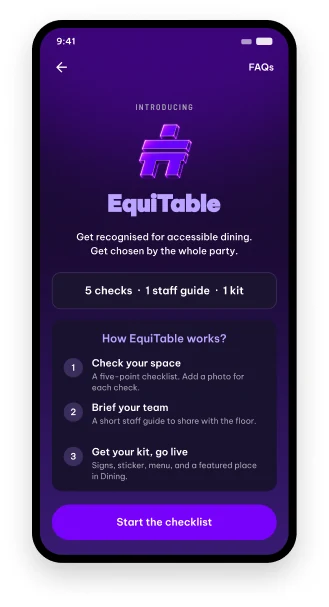
  1. Introducing EquiTable for partners: 5 checks, 1 staff guide, 1 kit, and Start the checklist

    1 · EnrolIntroduced like any District feature, in three steps.
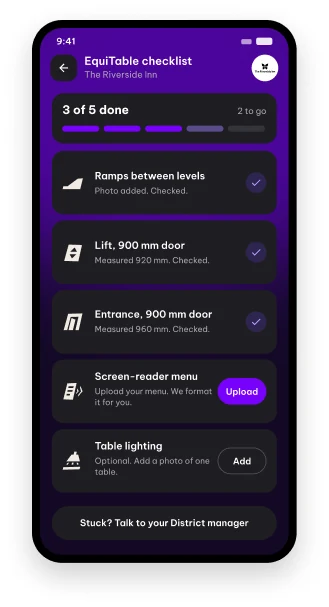
  2. EquiTable checklist: 3 of 5 done, each check with a photo and a measurement

    2 · Check the spaceA photo and a measurement per check.
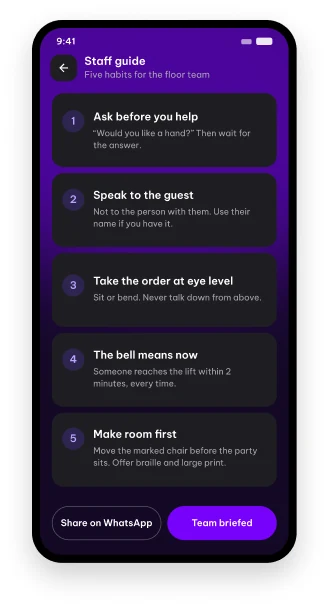
  3. Staff guide: five habits for the floor team, shared on WhatsApp

    3 · Brief the teamFive habits, shared in one tap.
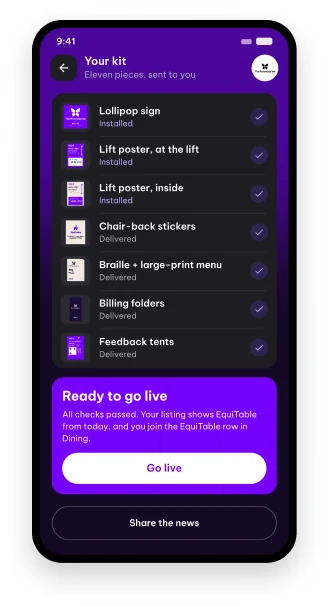
  4. Your kit: eleven pieces installed or delivered, and a Go live button

    4 · Kit, then go liveThe kit arrives. One button.
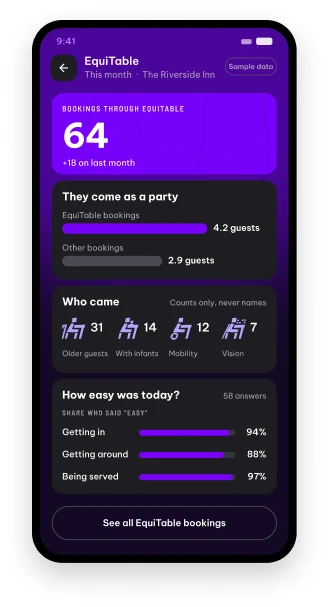
  5. Partner dashboard with sample data: bookings through EquiTable, party size, who came, and how easy the evening was

    5 · See who cameParty size, and how the evening went. Sample data.

Scroll to see all five →

Two launch films

The story, cut down for owners’ feeds: 72 seconds for LinkedIn and 36 for an Instagram Reel, both ending on the same ask, become an EquiTable partner. Every scene is built from parts of the system: the six-seat table, the mark building itself, the five checks and the partner screens.

Output · LinkedIn film, 16:9, 1:12 · Watch on YouTube ↗
Output · Instagram Reel, 9:16, 0:36 · Watch on YouTube ↗